Arahura Valley
The LuminariesArahura Valley is both the setting of Crosbie Wells’s secluded life and the ground on which the novel makes colonial ownership materially visible. Its river drew Te Rau Tauwhare in search of pounamu and brought him into friendship with Wells; its land was sold under a system that restricted Poutini Ngāi Tahu to a fraction of their former territory. After Wells’s death, the cottage and its hidden gold turned that landscape into the focus of competing claims, while Tauwhare’s continuing attachment to the valley exposes the distance between legal possession and a lived relationship to land.
Geography and contested ownership
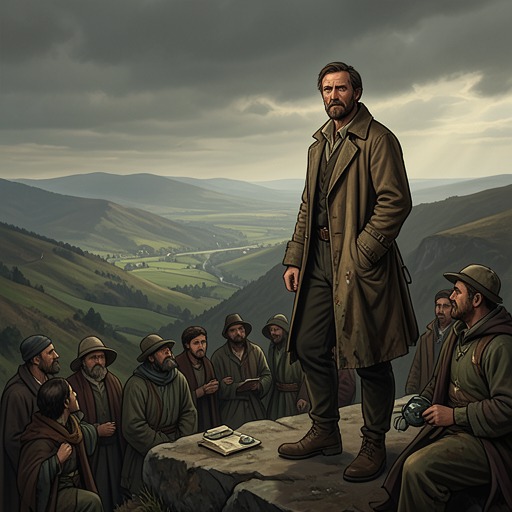
Arahura Valley lies inland from the West Coast, with the Arahura River running through it. The river was prized for pounamu: stones whose plain, milky-grey surfaces concealed a glassy green interior. Te Rau Tauwhare was an especially skilled hunter of the stone. Rather than splitting promising pieces at the riverbank, he carried them back to Mawhera untouched, for blessing and ceremonial breaking. The valley was therefore not simply a remote backdrop or a source of mineral wealth; it belonged to a network of travel, knowledge, and customary practice.
That relationship had been radically unsettled by the Crown’s purchase of Poutini Ngāi Tahu territory. Six years before the events described, the Crown had bought an extensive tract of the western South Island for three hundred pounds, leaving Poutini Ngāi Tahu only the Arahura River, portions of its banks, and a small parcel at Mawhera, near the mouth of the Grey River. The subsequent influx of diggers made the imbalance unmistakable: prospectors paid a pound for a licence and ten shillings per acre for land, while the value of the gold in the rivers and sands remained beyond calculation. For Tauwhare, this was not an abstract grievance. The wealth and land that should have remained with his people had become the basis of other people’s profits.
Wells’s cottage and Tauwhare’s visits
Crosbie Wells acquired one hundred rolling acres at the eastern end of the valley for fifty pounds, paying the Crown rather than Poutini Ngāi Tahu. His property bordered the portion of land to which the iwi had recently been confined. Wells built a one-room cottage overlooking the river, cleared a garden space, and began constructing a timber mill. The acreage was thick with tōtara, a fine-grained timber that could be worked with a knife and resisted salt and storms. Wells’s plans joined practical labour to the promise of a return from the land; his enthusiasm for work was matched by his appetite for whisky or, when it was unavailable, gin.
The sound of Wells’s axe splitting kindling first drew Tauwhare to the cottage. Their acquaintance began cordially and became a habit: when Tauwhare was nearby, he called in. Wells was eager to learn about Māori life and lore, and questioned his visitor about belief, spirituality, and Ngāi Tahu identity. Tauwhare, who was keen to speak about those parts of himself that he privately worried might be shallow, found in Wells an unusually attentive listener. Wells, by contrast, revealed little of his own past, and Tauwhare was not inclined to interrogate him. Still, Tauwhare regarded him as a kindred spirit. Their visits acquired a domestic rhythm: Tauwhare brought meat, Wells supplied spirits, and each man accepted the arrangement.
Death, the cottage, and the road to Hokitika
The valley became the site of a consequential mystery when Wells died in his cottage. On the morning after his death, Tauwhare arrived with food and encountered a cart leaving the clearing. Dr. Gillies, the physician, and Cowell Devlin, the gaol-house chaplain, were taking Wells’s body toward Hokitika to be prepared for burial. Tauwhare recognised the boots and the form beneath a folded blanket, cried out, and dropped his gift. Offered a place on the back of the cart, he rode with his hand loosely gripping Wells’s ankle as the body jolted over the road. Onlookers watched from doorways along Revell Street; at the Police Camp, Tauwhare remained beside the cart while the other men conferred. The journey brought Wells’s private death into public view, but Tauwhare’s vigil kept the emphasis on the friend he had lost.
Tauwhare’s account also became an important clue in the investigation of Wells’s final days. He had seen Francis Carver enter the cottage on the day Wells died, before Alistair Lauderback arrived. Lauderback later testified that Wells’s kettle was still boiling when he entered, suggesting that he had arrived not long after the death. The sequence raised the possibility that Carver had been inside before Wells died, or had even witnessed his death. When Benjamin Löwenthal and Thomas Balfour considered the timing, Carver’s rapid departure aboard the Godspeed later that evening seemed suspicious. Tauwhare’s friendship with Wells had given him access to the cottage and its history; after Wells’s death, that same closeness made his observations consequential evidence.
Gold, title, and the meaning of the valley
Wells had made a fortune on the Dunstan goldfields years earlier, but kept his wealth secret and lived in the valley without being known as a man of consequence. After his death, Edgar Clinch commissioned Harald Nilssen to clear the cottage and dispose of its contents. Nilssen found gold hidden throughout the single room. Once purified by the bank, it was valued at a little over four thousand pounds. The discovery did not exhaust the fortune connected to Wells: gold sewn into five dresses had circulated elsewhere, and one portion remained concealed in Anna Wetherell’s orange gown. The valley’s cottage was thus one repository within a wider movement of gold through property, clothing, and claims to inheritance.
Clinch’s purchase of the acreage gave him legal title, and he arranged for Wells’s belongings to be removed, but the sale did not settle what the valley meant or to whom it belonged. Tauwhare was troubled that Clinch had bought the land for profit without first walking its boundaries or undertaking work there. In his view, the buyer treated land as a form of currency, although the tract’s value could not be measured by the proceeds of a sale or by whatever could be stripped from Wells’s cottage. The contrast is sharpened by Tauwhare’s intimate knowledge of the West Coast: he had travelled its length and understood the Arahura as a central place within Te Tai Poutini, not an interchangeable parcel.
For Tauwhare, the river was an axis of belonging, and Wells’s cottage, set in the valley between mountains and ocean, had become a personal landmark within that landscape. Yet neither he nor his hapū nor his iwi could claim the property under the law that transferred it to Clinch. That contradiction gives Arahura Valley its larger significance in the novel: it is at once a particular home, a source of pounamu and concealed gold, and a disputed possession. The fortunes uncovered there can be counted and transferred; Tauwhare’s attachment to the land cannot be reduced to a price or erased by a legally completed sale.